 khoji park
Robots · Utopia Planitia, Mars · 2023
The Mars Rover Slept Through Winter. Its Wake-Up Signal Never Came.
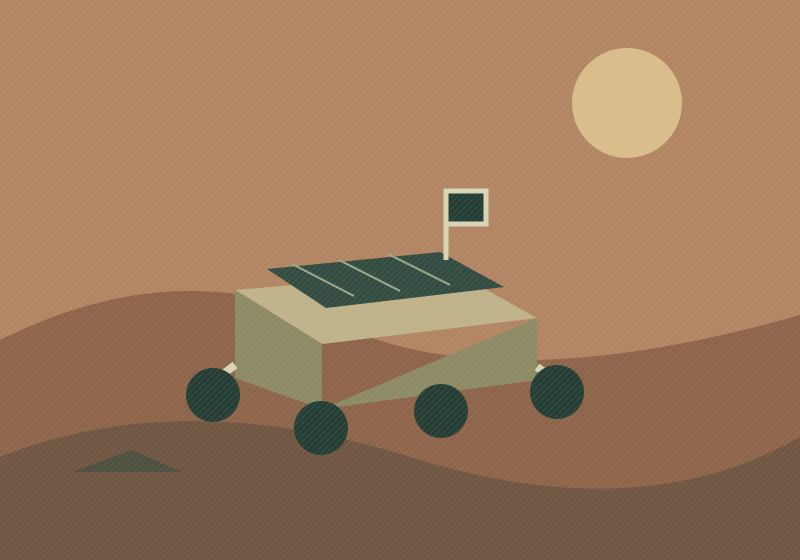
The solar-powered rover remained inactive in Utopia Planitia after failing to restart following the Martian winter.
 Read in slides
1. Tianwen-1 Mission Launch
China launched its Tianwen-1 interplanetary mission on 23 July 2020 using a Long March 5 heavy-lift rocket from the Wenchang Spacecraft Launch Site. The spacecraft carried an orbiter, a lander, and the Zhurong rover toward the Martian system. After a 202-day journey through space, the spacecraft successfully inserted itself into Martian orbit on 10 February 2021. This milestone made China's mission the country's first successful probe to orbit another planet.
The spacecraft prepared for upcoming landing attempts.
2. Successful Landing in Utopia Planitia
The lander and Zhurong rover separated from the Tianwen-1 orbiter on 14 May 2021 and performed an atmospheric entry. Using a combination of an aeroshell, a parachute, and retrorockets, the lander made a successful soft landing in Utopia Planitia. This achievement marked China as the second nation to operate a fully functional rover on the Martian surface. High-resolution images of the surrounding terrain were successfully transmitted back to Earth shortly after landing.
Surface operations began following successful deployment.
3. Rover Deployment and Initial Operations
Zhurong drove off its landing platform onto the Martian soil on 22 May 2021 to begin its surface exploration mission. The six-wheeled rover carried six scientific instruments designed to examine local topography, soil properties, and atmospheric conditions. Early operations included capturing panoramic views of the landing site and deploying a wireless camera to photograph the lander. The initial operational plan structured activities into repeating three-sol cycles for navigation and data collection.
Scientific payloads began active data gathering.
4. Visiting Parachute and Backshell
Zhurong drove south from its landing site and approached the parachute and backshell used during its descent. On 12 July 2021, the rover utilized its navigation and topography camera to capture detailed images of the discarded hardware. The captured imagery displayed the complete parachute structure alongside the thermally abraded backshell and visible altitude control thruster ports. Mission controllers used these observations to verify descent models.
The rover continued its journey toward southern Utopia Planitia.
5. Surpassing Primary Mission Goals
By 15 August 2021, Zhurong had officially completed its planned 90-sol primary exploration tasks. Due to the vehicle's stable performance, engineers accelerated operations by merging the original three-day task cycles into single-day periods. The CNSA announced an extended expedition with the objective of investigating an ancient coastal area in southern Utopia Planitia. The rover successfully navigated through sand dunes while collecting ongoing meteorological and geological measurements.
Extended exploration tasks proceeded southward across the plains.
6. Entering Planned Hibernation
As the Martian winter approached along with major dust storm activity, mission controllers switched Zhurong to a sleeping mode on 18 May 2022. The hibernation protocol aimed to protect the vehicle's sensitive components from extreme cold temperatures reaching minus 100 degrees Celsius in Utopia Planitia. The solar-powered rover was engineered to restart automatically once internal power levels reached 140 watts and key internal parts warmed sufficiently. An expected awakening date was projected for December 2022.
The rover remained dormant awaiting solar energy recovery.
7. Absence of Awakening Signals
In January 2023, CNSA scientists confirmed that no communication signals had been received from Zhurong following the projected awakening window. The Tianwen-1 orbiter and NASA's Mars Reconnaissance Orbiter were utilized to inspect the rover's recorded location. Orbital images confirmed that the vehicle had not changed its position between September 2022 and February 2023. Analysis indicated that excessive dust accumulation on the solar panels severely restricted energy generation.
Orbital observations tracked the unchanging position of the rover.
8. Assessment of Permanent Inactivation
Mission designer Zhang Rongqiao announced on 25 April 2023 that the buildup of dust on the solar panels was significantly greater than initially anticipated. Without sufficient solar radiation to power internal heaters and clear debris, the vehicle's automated restart sequence could not initiate. The lack of a radioisotope heater unit left the rover vulnerable to extreme low temperatures throughout the winter season. These combined factors indicated that the rover was unlikely to resume operations.
Engineers evaluated the mission limits based on orbital data.
9. Scientific Discoveries from Transmitted Data
Data returned by Zhurong prior to its hibernation yielded important findings regarding Martian climate history and surface composition. Spectral measurements identified hydrated sulfates, opal, and iron oxide minerals within dune crusts, suggesting the past presence of liquid saline water. Additionally, analysis of topographical features such as pitted cones and mud volcanoes provided supporting evidence for an ancient ocean in Utopia Planitia. The returned dataset totaled 1,480 gigabytes before communication ceased.
Researchers analyzed the collected geological samples and atmospheric measurements.
10. Concluding Mission Status
Zhurong entered hibernation in May 2022 and did not resume the planned operations after the expected seasonal change. In April 2023, Chinese mission officials described dust on the solar panels as a possible obstacle to obtaining enough power to wake. That explanation concerned the absence of renewed communication; it did not independently prove the permanent condition of every component on the rover.
The cited update reported no successful seasonal wake-up.